Choosing the 2026 Best Heat Loss Insulation for Global Buyers requires more than comparing advertised R-values. Climate, wall design, humidity, installation quality, and local building codes can change the result. No material wins everywhere.
Heat Loss Insulation should be evaluated as part of a complete building envelope. Building scientist Joseph Lstiburek states, “The building enclosure is a system, not a collection of parts.” His point remains practical. A thick insulation layer cannot correct thermal bridges, compressed batts, open joints, or uncontrolled air leakage. A cold bedroom wall, a damp roof corner, or a warm patch around a window often reveals these weaknesses.
Details matter.
This guide compares mineral wool, fiberglass, expanded polystyrene, extruded polystyrene, polyurethane foam, and natural-fiber options. It considers thermal resistance, moisture behavior, fire performance, durability, installation tolerance, environmental impact, and regional availability. Buyers should also check declared performance data, third-party testing, and compliance with applicable standards. Values measured in laboratories may differ from results on a busy construction site. That gap deserves attention.
A reliable choice balances energy savings with safe, serviceable construction. In tropical regions, vapor control and moisture drying may matter most. In cold regions, continuous exterior insulation can reduce condensation risks. In noisy urban buildings, density and acoustic performance add value. Costs also vary sharply between continents, so delivered price matters more than catalog price. The best answer is not always the newest product. Sometimes, better detailing beats a higher specification.
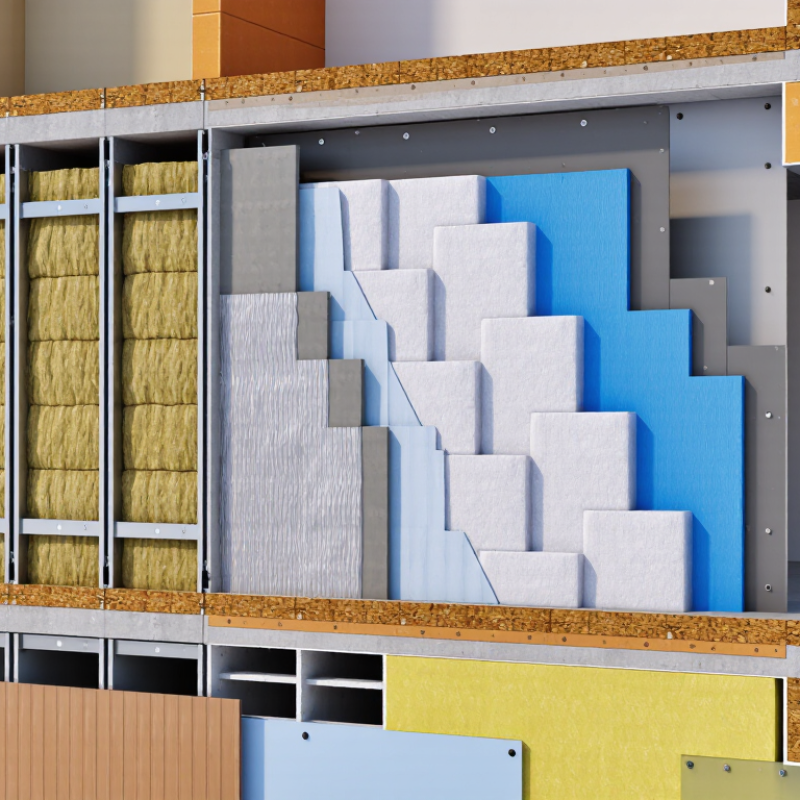
Heat-Loss Insulation Basics: U-Values, R-Values, and Thermal Conductivity
For global buyers, heat-loss insulation starts with three measurements: U-value, R-value, and thermal conductivity. They describe different parts of thermal performance, so they should not be treated as interchangeable.
U-value measures heat flow through a building element. It is usually expressed in W/m²K. Lower values indicate better resistance to heat transfer. R-value shows resistance instead. Higher values generally mean stronger insulation, but units vary between metric and imperial systems. Always check the measurement basis before comparing products. Thermal conductivity, written as W/mK, describes how easily heat passes through the insulation material itself. Lower conductivity is usually preferable.
The basic relationship is practical: R-value increases with thickness and decreases as conductivity rises. For a simple layer, R equals thickness divided by conductivity. A whole wall also includes air films, framing, membranes, and thermal bridges. Therefore, a high product R-value may not equal a high wall performance. On site, gaps around windows and compressed sections often create visible cold spots. Air leakage can matter more than expected. Moisture changes performance too, especially when insulation becomes damp.
I have seen specifications look impressive while installation details remained unclear. That is a warning sign. Ask for tested values, declared thickness, moisture conditions, and the complete assembly U-value. Climate matters as well. A cold, windy region may need careful air sealing, while a hot, humid region requires stronger moisture control. Numbers help, but workmanship still decides what the building actually delivers.
Selecting Insulation by Climate: ASHRAE Zones, Moisture, Fire, and Durability
In 2026, insulation selection should begin with climate, not with a product label. ASHRAE Standard 169-2021 divides locations into thermal and moisture zones. A cold, dry zone may prioritize high thermal resistance. A hot, humid zone needs continuous insulation and careful vapor control. The wall must dry safely after rain.
Moisture changes the real performance of insulation. Wet fiber-based materials can lose effectiveness and encourage biological growth. Closed-cell materials resist water better, but joints and penetrations still require precise detailing. Field experience matters here.
A small gap beside a window can defeat a large area of insulation. The U.S. Department of Energy reports that air leakage can account for 25% to 40% of heating and cooling energy use in typical homes. That makes installation quality impossible to ignore.
Fire performance also varies by assembly, not only by insulation type. Buyers should request tested wall-system evidence, including reaction-to-fire classification and fire-resistance duration. ASTM and ISO test methods can support comparison, but local codes remain decisive. Durability deserves equal attention.
The 2024 Global Status Report for Buildings and Construction estimates that buildings consume about 32% of global energy and produce roughly 34% of global carbon dioxide emissions. Long-lasting insulation can reduce replacement waste, yet its embodied carbon should be checked.
No chart is perfect. For coastal sites, salt air, wind-driven rain, ultraviolet exposure, and maintenance access may matter more than a laboratory R-value. A practical specification should state climate zone, moisture strategy, fire test, expected service life, and inspection requirements.
Installation Standards: Thermal Bridges, Air Leakage, and EN 13162 Performance
For global buyers, EN 13162 offers a practical benchmark for factory-made mineral wool insulation. It covers declared thermal conductivity, thickness, dimensional stability, and fire performance. These values describe the product, not the finished wall. Installation quality still controls real heat loss.
Thermal bridges appear at slab edges, window reveals, anchors, and poorly aligned joints. Insulation should meet tightly at corners, with staggered seams and no visible gaps. Air leakage is different. Even high-performing insulation cannot stop drafts through service penetrations, damaged membranes, or loose junctions. A continuous airtight layer needs careful detailing and inspection. Small openings matter.
Tips: Request the Declaration of Performance, λD value, thickness tolerance, and batch traceability. Check EN 13162 test information against project conditions. During installation, photograph difficult junctions before closing the wall. Use smoke testing or a blower-door test where practical. Do not rely on visual inspection alone.
Site reviews often find compressed insulation behind pipes or gaps around window frames. These defects are easy to miss. I would also question unusually perfect test claims without supporting documents. A product may meet its declared standard while the installed assembly performs poorly. That uncomfortable distinction deserves attention before purchase.
Buyer’s Checklist: Cost, Carbon Impact, Certifications, and Service Life Over 50 Years
In 2026, global buyers should judge heat-loss insulation beyond price per square metre. A practical assessment begins with climate, wall assembly, moisture exposure, and installation quality. In a cold coastal warehouse, wind-driven rain can matter as much as thermal conductivity. Ask for tested conductivity, density, fire performance, and dimensional stability. Request results at realistic temperatures, not laboratory conditions alone.
Costs hide easily. Include transport, cutting waste, protective equipment, labor, maintenance, and future replacement. A cheaper product may lose its advantage if it absorbs moisture or needs complex detailing around pipes and windows. Carbon impact deserves equal scrutiny. Review recycled content, manufacturing energy, transport distance, packaging, and end-of-life options. Prefer verified life-cycle data over broad marketing claims. Check dates. Carbon figures can vary by factory, energy mix, and reporting boundaries.
Certifications should be traceable to an independent testing body and relevant regional standards. Confirm scope, validity, fire classification, and matching installation conditions. For a 50-year service-life target, examine aging tests, moisture resistance, compression recovery, and warranty terms. A warranty is not proof of durability. It is only one signal. I would not promise fifty years without reviewing the roof, envelope, and maintenance plan. Keep records. The uncomfortable question remains: will installation quality deliver the advertised performance?
2026 Best Heat Loss Insulation for Global Buyers - Buyer’s Checklist: Cost, Carbon Impact, Certifications, and Service Life Over 50 Years
| Insulation Type |
Typical Thermal Conductivity
(λ, W/m·K) |
Approx. Thickness for
R-20 / RSI 3.5 |
Indicative Material Cost
(USD/m²) |
Indicative Embodied Carbon
(kg CO₂e/m², A1–A3) |
Common Standards and Certifications to Request |
Expected Service Life |
Moisture and Fire Considerations |
50-Year Buyer Assessment |
| Mineral Wool |
0.034–0.041 |
120–145 mm |
$8–$22 |
15–40 |
EN 13162; ASTM C612 or ASTM C665; ISO 10456; EN 13501-1 fire classification; third-party EPD preferred |
50+ years when kept dry and mechanically secure |
Non-combustible grades are commonly available. Water-resistant treatment may be needed in exposed locations. Must be protected from persistent wetting. |
Excellent |
| Glass Wool |
0.032–0.040 |
115–140 mm |
$6–$18 |
10–30 |
EN 13162; ASTM C665; ISO 14025 or EN 15804 EPD; EN 13501-1 or ASTM E84 fire data |
50+ years in a dry, undisturbed assembly |
Generally non-combustible or highly fire resistant, depending on the product. Compression and moisture control are important for long-term performance. |
Excellent |
| Cellulose Fibre |
0.038–0.042 |
135–150 mm |
$7–$18 |
-5 to 15 |
EN 15101-1; ASTM C739; ASTM C1149 for spray-applied systems; recycled-content documentation; fire-treatment evidence; EPD preferred |
50+ years when installed at the specified density and protected from leaks |
Good air-sealing potential when dense-packed. Hygroscopic and must be protected from bulk water. Fire performance depends on formulation, density, and assembly design. |
Excellent |
| Wood Fibre Board |
0.038–0.050 |
135–175 mm |
$15–$40 |
-20 to 25 |
EN 13171; EN 13501-1; EN 15804 EPD; FSC or PEFC chain-of-custody evidence where applicable |
50+ years when detailed to remain dry and protected from insects |
Can provide useful vapour buffering. Moisture design, rainscreen detailing, and suitable fire classification are essential. |
Excellent |
| Expanded Polystyrene (EPS) |
0.031–0.038 |
110–135 mm |
$7–$18 |
15–35 |
EN 13163; ASTM C578; EN 13501-1 or ASTM E84; recycled-content declaration; EPD preferred |
50+ years when protected from UV, solvents, fire, and physical damage |
Low water absorption compared with fibrous products, but joints and perimeter detailing matter. Combustible and normally requires a tested protective assembly. |
Very Good |
| Extruded Polystyrene (XPS) |
0.029–0.036 |
100–125 mm |
$12–$28 |
25–55 |
EN 13164; ASTM C578; EN 13501-1 or ASTM E84; water-absorption and compressive-strength testing; EPD preferred |
50+ years in below-grade or protected applications |
Useful where compressive strength and moisture resistance are required. Combustible; verify fire protection and blowing-agent environmental data. |
Very Good |
| PIR / Polyisocyanurate Board |
0.022–0.028 |
80–100 mm |
$14–$35 |
35–70 |
EN 13165; ASTM C1289; EN 13501-1 or ASTM E84; EN 15804 EPD; declared blowing-agent and fire-test data |
50+ years when protected from moisture, UV, and mechanical damage |
High thermal performance per millimetre. Actual fire behaviour varies significantly by facing, joints, thickness, and tested assembly. |
Very Good |
| Spray Polyurethane Foam |
0.025–0.035 |
90–125 mm |
$20–$50 |
40–90 |
EN 14315-1; ASTM C1029; ASTM E84; installer qualification; adhesion, density, and closed-cell content testing; EPD preferred |
25–50+ years, depending strongly on formulation, installation, UV exposure, and substrate movement |
Can reduce air leakage effectively, but application quality is critical. Requires fire protection and careful control of moisture, ventilation, and chemical handling. |
Conditional |
| Silica Aerogel Blanket |
0.013–0.020 |
45–70 mm |
$60–$180 |
50–120 |
ASTM C1728; EN 12667; ISO 8301; EN 13501-1 or ASTM E84; product-specific EPD and fire certification |
50+ years when protected from abrasion, water ingress, and compression |
Excellent performance where space is limited. High cost and careful handling are required; verify dust control, facing, flexibility, and compression limits. |
Very Good for Retrofit |
Buyer’s checklist: Cost figures are indicative material-only ranges in 2026 USD per square metre for insulation providing approximately R-20 (RSI 3.5); installation, transport, labour, vapour control, fire protection, and taxes are excluded. Embodied-carbon values are screening ranges for product-stage impacts (A1–A3), not guarantees for every product. Request a current third-party EPD, verified thermal resistance at the design temperature, fire classification for the complete assembly, water-absorption data, compressive strength where relevant, installation instructions, and a documented durability or warranty statement. A 50-year service life depends on correct design, dry conditions, UV protection, pest control, and maintenance.
Conclusion
This guide to 2026 Best Heat Loss Insulation for Global Buyers explains how insulation performance is measured through U-values, R-values, and thermal conductivity, helping buyers compare materials on a consistent basis. It reviews mineral wool, EPS, XPS, PIR, and cellulose according to thermal efficiency, moisture resistance, fire performance, environmental impact, and expected durability. The guide also shows how climate conditions, including ASHRAE zones, humidity, and temperature variation, should influence material selection.
Beyond product data, the article highlights the importance of correct installation. Reducing thermal bridges, controlling air leakage, and checking EN 13162-related performance requirements can significantly improve real-world energy efficiency. A practical buyer’s checklist covers total cost, carbon impact, certifications, maintenance needs, and service life exceeding 50 years. By considering both material properties and installation quality, global buyers can choose Heat Loss Insulation that delivers reliable comfort, lower energy demand, and long-term building performance.
 Kingflex
