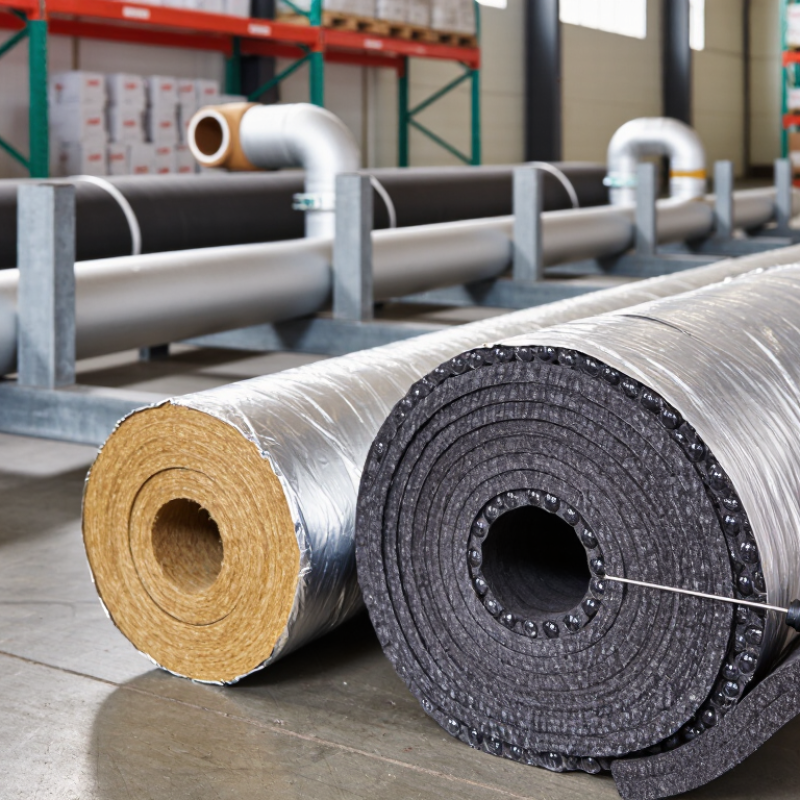
| Flexible Elastomeric Foam |
Approximately 0.033–0.040 W/m·K |
Approximately −50°C to +105°C, depending on formulation |
Usually high; closed-cell products commonly have a water-vapor resistance factor above 7,000 |
Excellent when joints, seams, and pipe supports are sealed correctly |
Chilled-water pipes, refrigerant lines, condensate drains, fan-coil connections, and low-temperature HVAC piping |
Closed-cell structure, flexible installation, good condensation resistance, and no separate vapor retarder in many applications |
Requires careful adhesive and seam treatment; surface damage can reduce moisture protection |
Best all-round choice for indoor chilled-water and refrigerant pipe systems |
| Polyethylene Foam |
Approximately 0.035–0.045 W/m·K |
Approximately −40°C to +90°C |
Generally high for closed-cell products, but lower than many elastomeric systems at poorly sealed joints |
Good for moderate humidity and standard indoor service; sealing is essential for cold pipes |
Small-diameter chilled-water pipes, air-conditioning copper lines, domestic HVAC branches, and protected indoor pipework |
Lightweight, economical, easy to cut, and available in pre-slit tubes |
Lower temperature capability and lower flexibility than elastomeric foam; may shrink or deform if exposed to excessive heat |
Best for cost-sensitive indoor systems with moderate temperature and humidity requirements |
| Glass Wool |
Approximately 0.032–0.045 W/m·K |
Typically up to approximately +250°C for insulation material; facing and binder limits may be lower |
Low unless supplied with a properly sealed vapor-retarder facing |
Suitable for dry, warm, or hot services; cold pipes require a continuous vapor barrier |
Hot-water pipes, heating systems, ventilation ductwork, and larger HVAC pipes in dry service areas |
Low weight, good thermal performance, sound absorption, and generally non-combustible fiber |
Fibers can absorb moisture; compression reduces performance; protective facing and installation precautions are required |
Best for heating pipes and larger warm-air or ventilation systems where fire performance and acoustics matter |
| Rock Wool |
Approximately 0.034–0.045 W/m·K |
Typically up to approximately +650°C for the insulation material; system components may have lower limits |
Low unless protected with a continuous vapor-retarder jacket |
Good in dry service; not suitable for exposed wet conditions without weatherproof cladding |
Heating water, high-temperature pipework, plant rooms, mechanical rooms, and fire-sensitive HVAC installations |
High temperature resistance, non-combustible mineral fiber, and good acoustic performance |
Rigid and heavier than flexible foam; cold-service installations need meticulous vapor-barrier detailing |
Best for high-temperature or fire-sensitive HVAC pipe systems |
| Calcium Silicate |
Approximately 0.050–0.070 W/m·K |
Approximately +40°C to +650°C, depending on product grade |
Low without an external vapor barrier or weatherproof finish |
Performs well in dry high-temperature service; must be protected from water ingress |
High-temperature hot-water, steam, and industrial HVAC pipework |
Strong under compression, non-combustible, and suitable for high-temperature applications |
Higher thermal conductivity than many flexible foams; brittle and more labor-intensive to install |
Best for hot service where mechanical strength and high-temperature stability are priorities |
| Aerogel Blanket |
Approximately 0.013–0.020 W/m·K |
Approximately −200°C to +650°C, depending on the product construction |
Varies by composite facing and installation system |
Good thermal performance in restricted spaces when seams and outer protection are properly finished |
High-performance retrofit work, compact plant rooms, difficult pipe configurations, and selected hot or cold services |
Very low thermal conductivity, thin profile, and strong performance where space is limited |
Higher cost; installation quality, dust control, mechanical protection, and compatible jacketing are important |
Best for premium or space-constrained projects rather than routine low-cost HVAC installations |
 Kingflex