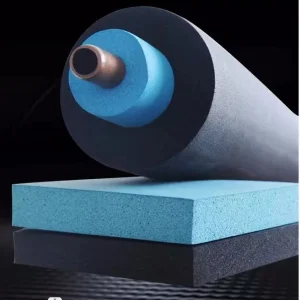
China Copper Pipe Insulation Sizes Manufacturer & Suppliers
Precision-Engineered Elastomeric Thermal & Cryogenic Solutions. Meeting Global ASTM, BS, and CE Standards for Optimal HVAC, LNG, and Cleanroom Systems.
Premium Thermal Insulation Catalog
Explore our certified elastomeric and cryogenic rubber foam products engineered for global engineering specifications.
Understanding Copper Pipe Insulation Sizes: Thermal Performance & Material Selection
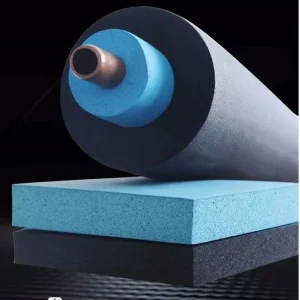
In modern building infrastructure, refrigeration, and industrial fluid dynamics, the selection of the correct copper pipe insulation sizes is critical. Copper pipes are highly conductive elements; without precision-engineered insulation, they suffer from extreme thermal loss and condensation issues. Effective insulation relies on selecting the proper thickness of elastomeric rubber foam relative to the copper pipe’s outer diameter (OD). This prevents the outer boundary temperature of the insulation from falling below the atmospheric dew point, avoiding structural moisture damage and mold formation.
From a thermal engineering standpoint, heat transfer from a cylinder is described by radial heat flow equations. If the insulation thickness is insufficient, the thermal barrier fails. Conversely, exceeding the "critical radius of insulation" can paradoxically increase heat dissipation in very small tubes. For commercial HVAC and cryogenic applications, calculating the exact required wall thickness is key to system efficiency. Kingflex Insulation Co., Ltd. provides optimized NBR/PVC elastomeric formulations designed to maintain stable thermal conductivity ($k$-value $\le 0.035 \text{ W/(m}\cdot\text{K)}$ at $0^\circ\text{C}$) over decades of service life.
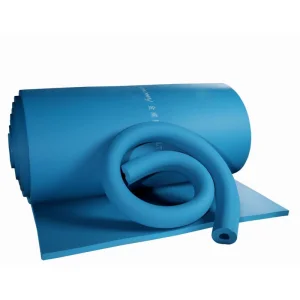
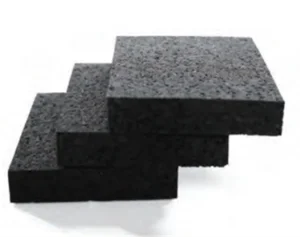
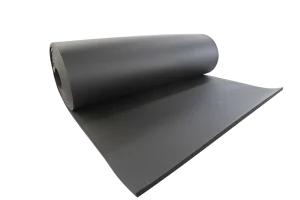
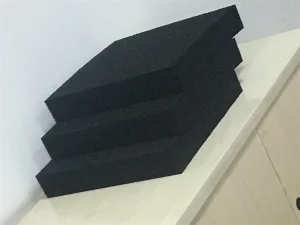
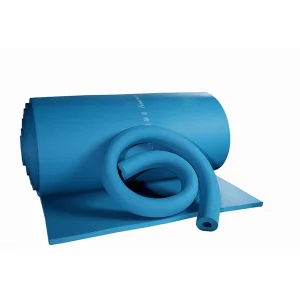
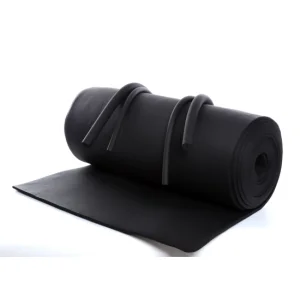
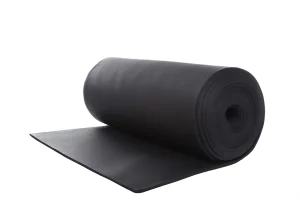
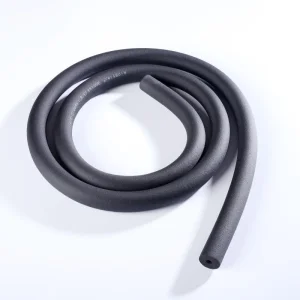
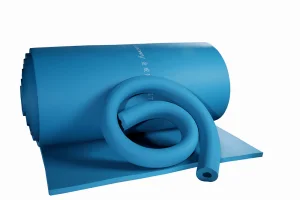
Black Rubber Foam Insulation Sheet Roll Specifications
Material MatrixPremium NBR/PVC Elastomeric Foam
Thickness Options6mm to 50mm Range
Volumetric Density40 to 55 kg/m³
Operational Temp-40℃ to 105℃
Closed Cell Rate> 98% Uniform Matrix
Compression Resilience> 80% Elastic Recovery
Water Vapor Permeability$\mu$-factor ≥ 10,000
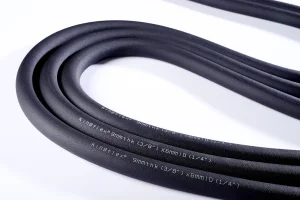
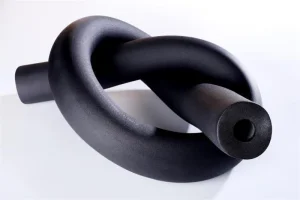
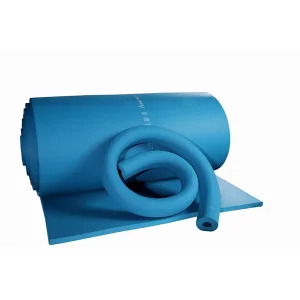
Black Rubber Foam Insulation Pipe Specifications
Material MatrixHigh-Grade Nitrile Elastomeric Blend
Wall Thicknesses9mm, 13mm, 19mm, 25mm, 32mm, 40mm
Inner Diameter (ID)6mm to 114mm (Compatible with Copper OD)
Density Density Range40 to 55 kg/m³
Service Limit-40℃ to 105℃ Max Limit
Flame PropagationClass 0 / Class 1 (BS 476 Part 6/7)
Thermal Conductivity≤ 0.034 W/(m·k) at 0℃
Nomenclature & Dimension Maps for Piping Engineers
When specifying copper pipe insulation sizes, it is important to match the pipe's Outer Diameter (OD) with the insulation's Inner Diameter (ID). Copper pipes are typically specified in Nominal Pipe Sizes (NPS) or outer diameters in millimeters or inches. For example, a 7/8" copper tube requires an insulation sleeve with an ID of approximately 22mm.
The table below outlines common copper pipe dimensions and matches them to our standard elastomeric insulation IDs and thickness configurations. This ensures a tight fit, preventing trapped air pockets that could lead to under-insulation corrosion.
Copper Pipe OD (Inches)
Nominal Copper Size (DN)
Insulation Pipe ID (mm)
Recommended Wall Thickness (HVAC)
Recommended Wall Thickness (Cryogenic)
1/4" (6.35mm)
DN 6
6mm - 8mm
9mm / 13mm
19mm / 25mm
3/8" (9.52mm)
DN 10
10mm - 12mm
9mm / 13mm
19mm / 25mm
1/2" (12.7mm)
DN 12
13mm - 15mm
13mm / 19mm
25mm / 32mm
5/8" (15.88mm)
DN 15
16mm - 18mm
13mm / 19mm
25mm / 32mm
7/8" (22.23mm)
DN 20
22mm - 25mm
19mm / 25mm
32mm / 40mm
1-1/8" (28.58mm)
DN 25
28mm - 30mm
19mm / 25mm
32mm / 40mm
1-3/8" (34.93mm)
DN 32
35mm - 38mm
25mm / 32mm
40mm / 50mm
2-1/8" (53.98mm)
DN 50
54mm - 57mm
25mm / 32mm
40mm / 50mm
4-1/8" (104.78mm)
DN 100
108mm - 114mm
32mm / 40mm
50mm
Kingflex Insulation: Historical Authority & Production Capacity
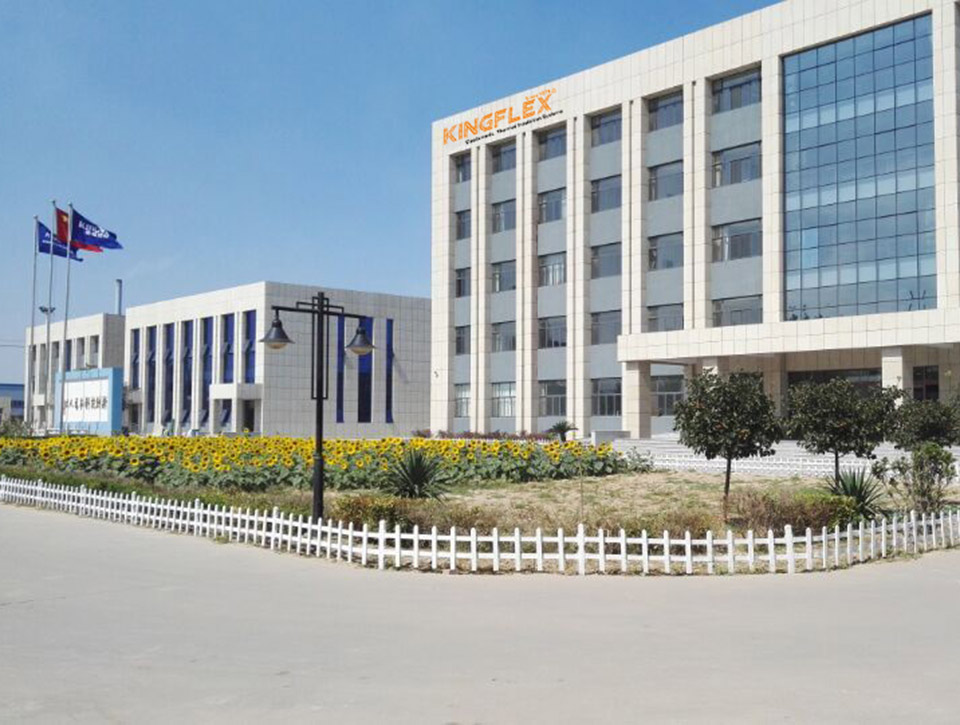
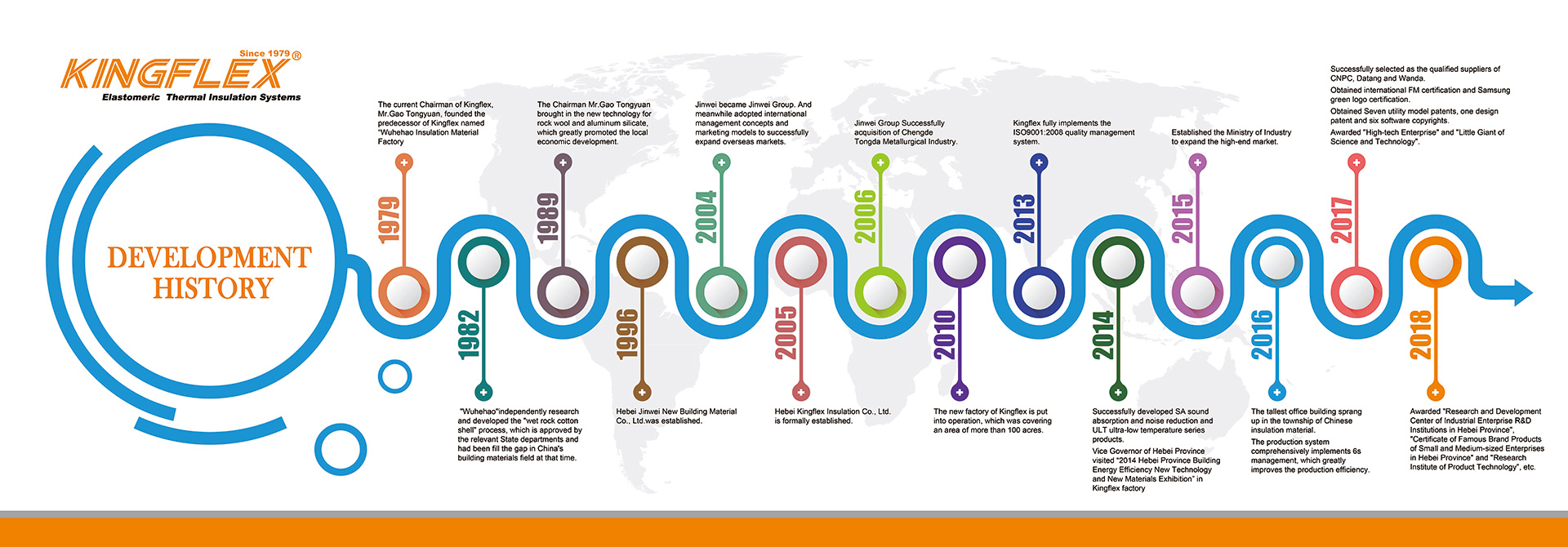
Established by the Jinwei Group, which has more than 40 years of history, Kingflex Insulation has developed from a regional pioneer into a key player in the green thermal insulation sector. Jinwei Group, founded in 1979, was the first manufacturer of thermal insulation materials north of the Yangtze River. Dacheng, China—frequently recognized as the capital of green building materials—hosts our advanced research, development, and manufacturing facility.
Today, Kingflex operates as an energy-saving, environmentally friendly enterprise focusing on the R&D, production, sales, and post-sale service of premium insulation. We prioritize energy savings and consumption reduction as core principles. Through our 5 automated production assembly lines, we achieve an annual output exceeding 600,000 cubic meters. This production scale has established Kingflex as a designated manufacturing enterprise for the Ministry of Energy, the Ministry of Electric Power, and the Ministry of Chemical Industry in China.
Advanced R&D Team & Engineering Quality Control
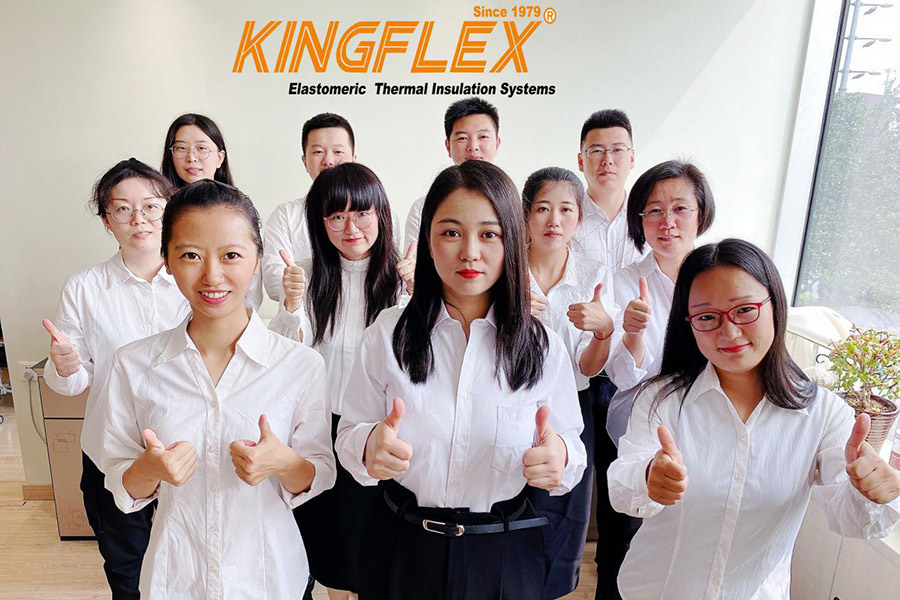
A key factor in our market presence is our commitment to research and development. The Kingflex team includes 8 professional engineers in our R&D Department, 6 international sales specialists, and over 230 skilled production employees. This structured workforce allows us to convert design concepts into certified industrial products.
Our NBR/PVC elastomer formulas are designed to prevent typical issues of premature aging, thermal drift, and environmental degradation. By ensuring uniform cell size, our insulation retains its thermal resistance value throughout its service life, even in challenging high-humidity environments.
As industries move toward carbon-neutral operations, thermal systems are under close review. Standard insulation solutions are transitioning to high-barrier elastomeric configurations. Kingflex supports global industries with targeted, application-specific insulation systems:
Civil HVAC & District Cooling
High-occupancy structures require flame-retardant, low-smoke emission insulation. Our Class 0 and Class 1 rated NBR/PVC foam pipes limit flame spread during structural fire emergencies.
Cryogenics & LNG Liquefaction
For temperatures down to -200°C, ordinary insulation cracking is a critical risk. Kingflex cryogenic insulation materials use dense elastomeric structures to prevent thermal contraction fractures.
Chemical & Heavy Industries
Piping carrying corrosive chemicals requires insulation that does not react with moisture to form acids. Our chemically inert NBR/PVC base helps mitigate corrosion under insulation (CUI).
Looking ahead, Kingflex is integrating bio-based polymer matrices to decrease dependence on petrochemical feedstocks while maintaining thermal properties. Additionally, we are researching "smart insulation" with embedded sensor fibers that can detect under-insulation moisture accumulation in real-time, allowing operators to locate leaks before they cause piping failure.
China Factory 4.0: Supply Chain Resilience & Efficiency Advantages
Kingflex's manufacturing plant operates on lean manufacturing principles. Our 5 automatic assembly lines use digital temperature controls, automated vulcanization tunnels, and continuous extrusion machines. By integrating these processes, we minimize variation in cell density, ensuring consistent thermal conductivity across each production run.
Sourcing Security & Global Logistics Competence
Located near Beijing and Tianjin ports, our facility has direct access to primary maritime transport routes. We maintain strategic stockpiles of synthetic rubbers, foaming agents, and flame retardants to help buffer against raw material market volatility and support stable pricing. Over the past 16 years, Kingflex products have been exported to more than 66 countries, establishing standard shipping procedures for locations in Europe, North America, Southeast Asia, and the Middle East.
For large commercial and industrial developments, we offer customized logistics solutions, including sequential container loading, color-coded custom sizing labels, and humidity-controlled export packaging to ensure products arrive clean and ready for installation.
Localization Support & Compliance Standards
International building codes require strict adherence to national safety standards. Sourcing thermal insulation from global suppliers requires verifying certification documents. Kingflex products are tested by third-party testing institutions to confirm performance compliance:
British Standard (BS 476)
Our foam insulation achieves BS 476 Part 6 (Fire Propagation) and Part 7 (Surface Spread of Flame) ratings, making it suitable for high-density commercial HVAC specifications in Commonwealth regions.
UL 94 & ASTM Standards
Tested in accordance with ASTM C534 (Standard Specification for Preformed Flexible Elastomeric Cellular Thermal Insulation in Sheet and Tubular Form) and UL94 flammability standards.
REACH & RoHS Compliance
Our production formulations are free from halogenated fire retardants, CFCs, HCFCs, and PBDEs, ensuring compliance with European environmental and occupational health directives.
Technical Q&A: Copper Pipe Insulation
Expert insights on installation, dimension selection, and physical performance parameters.
Q1: What is elastomeric rubber foam insulation used for?
A1: It is primarily used for HVAC ducts, air conditioning piping systems, commercial building insulation, and cold/hot insulation on industrial pipelines to prevent thermal loss and condensation.
Q2: Is Kingflex rubber foam insulation fire resistant?
A2: Yes, our elastomeric rubber foam contains flame-retardant additives. It is self-extinguishing and meets building safety standards, including BS 476 Class 0/1 and UL 94 vertical burn certifications.
Q3: What is the difference between rubber foam and rock wool insulation?
A3: NBR/PVC rubber foam is a flexible, closed-cell material that provides natural moisture resistance, making it suitable for HVAC, cooling, and plumbing applications. Rock wool is a high-temperature resistant, fibrous mineral wool best suited for industrial steam systems and high-heat applications.
Q4: Do you provide customized insulation products?
A4: Yes, we provide full OEM support. We can manufacture customized inner diameters (ID), outer diameters (OD), wall thicknesses, and special external protective cladding (such as aluminum foil or UV-resistant layers) to meet specific design requirements.
Q5: What certifications do your products have?
A5: Kingflex products are certified under BS 476, CE, REACH, RoHS, UL94, and ASTM. This ensures compliance with standard building regulations and international safety guidelines.
Q6: Does Kingflex products have traceability?
A6: Yes, our quality management system ensures full traceability. Each production run is cataloged from raw NBR/PVC batch testing to final packaging and shipping records.
Q7: What thickness of Rubber foam insulation sheet roll can you produce?
A7: We produce elastomeric sheet rolls in standard thicknesses ranging from 6mm to 50mm to meet various thermal performance requirements.
Q8: What is the service life of rubber plastic pipe and board?
A8: When correctly specified, installed, and maintained, our indoor elastomeric insulation systems have an expected service life of 10 to 15 years.
Q9: How do I select the right insulation size for a 7/8" copper line?
A9: A 7/8" copper pipe has an outer diameter (OD) of 22.2mm. You should select an insulation sleeve with an inner diameter (ID) of 22mm or 25mm, depending on tolerances. For general air-conditioning systems, a wall thickness of 13mm or 19mm is recommended to prevent condensation.
Q10: Why does closed-cell percentage matter for copper pipe insulation?
A10: Closed-cell structures prevent water vapor transmission. If moisture penetrates the insulation cell matrix, the material's thermal conductivity increases, leading to condensation, energy loss, and potential corrosion. Our products maintain a closed-cell rate exceeding 98% to prevent moisture ingress.
Extended Industrial & Mechanical Insulation Range
Explore our specialized range of high-performance closed-cell tubes and specialty mineral insulation products.
 Kingflex